Refreshing Startup Ideas

Most startup ideas are repetitive, redundant, and not value-adding. This list of interesting startup ideas should serve as inspiration for new startup ideas and a learning ground for analysing their product mechanics and growth strategies.
1. Tydal

Screenshot of the Tydal.co landing page.
1.1 Building
- The Why: People constantly ask for product recommendations and talk about their problems on Reddit. But running ads on Reddit rarely works, and manually messaging people takes forever and gets your account banned for spam. Founders need a clean way to join these conversations naturally and find interested customers.
- The What: An AI tool that finds sales leads on Reddit for startup founders. Key Value Add: Automatically tracks Reddit discussions and drafts helpful replies, turning public forum posts into real customer leads without looking spammy or requiring hours of manual work.
- The How: Tydal scans subreddits for target keywords to find active discussions. It uses AI to write helpful, natural-sounding replies so founders can jump into conversations, share advice, and subtly mention their product without getting flagged by moderators.
- The Moat: Tydal’s AI is specially trained to understand Reddit’s culture and strict anti-spam rules. Once founders set up their keyword tracking and build up a history of successful customer conversations in Tydal, moving to a new tool would mean starting over and risking their Reddit accounts getting banned.
1.2 Marketing
- Reddit-First Organic Distribution: Rather than relying on cold ads or disruptive selling, Tydal’s core growth approach relies on value-first community engagement. By automating organic presence on high-intent subreddits, it converts public discussion threads into efficient lead generation channels.
- Micro-SaaS Growth Playbook: Based on a practical blueprint for executing Reddit-first marketing and validation (scaling a marketing SaaS to $2.4k/mo in 12 months):
- Hunt Pain Points (Controversial Sorting): Search subreddits like
r/entrepreneurandr/marketingsorting by controversial to find emotionally charged debates, which represent acute problems people are highly willing to pay to solve. - Look for Wallet Signals: Check LinkedIn and communities to see what expensive enterprise tools or manual services (like paying $200/mo to agencies for basic tasks) prospects are already paying for.
- Build a Strategically Imperfect MVP: Ship a fast, functional prototype addressing just one core feature. Focus on market positioning and user flow rather than getting stuck over-engineering.
- Provide Value before DMs: Join 5-7 target Slack channels, Discords, and subreddits. Actively answer questions and share templates/examples for 2-3 weeks to build trust before DMing prospects who mention active pain points.
- Use a 7-Day Card-Required Trial: Require a card up front to filter out uncommitted users. A payment method ensures they have skin in the game, leading to higher usage and valuable feedback.
- Scale via Operator Networks: Sponsor small, niche newsletters where every reader matches the target profile, rather than buying broad ads.
- Competition & Traction-First Sharing: Competitors validate demand. For B2B products, results matter more than building in public; save the behind-the-scenes content for when you already have traction.
- Hunt Pain Points (Controversial Sorting): Search subreddits like
2. Monarch Money
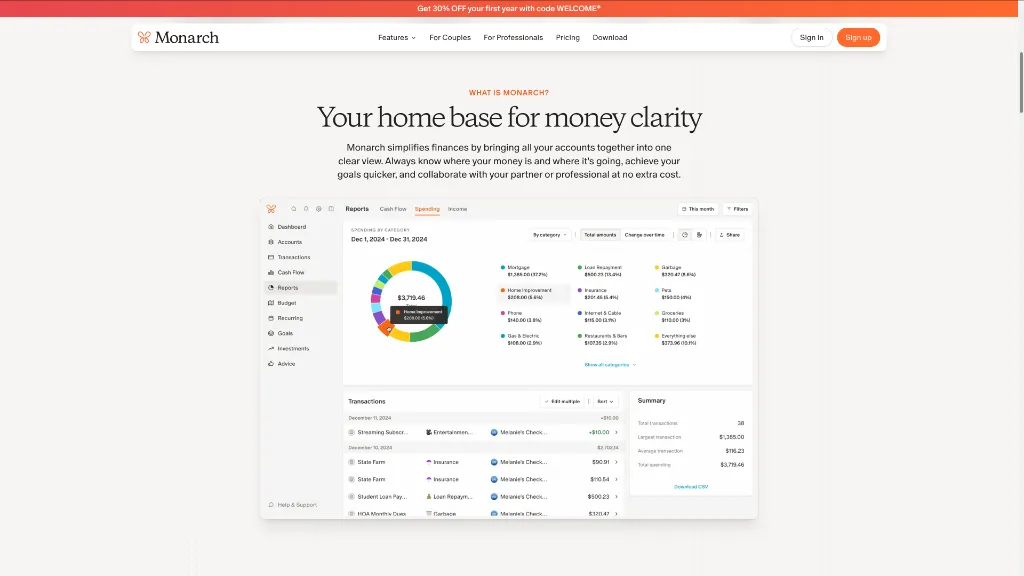
Screenshot of the MonarchMoney.com landing page.
2.1 Building
- The Why: Managing money across multiple bank accounts, credit cards, investments, and household bills is messy and stressful. Most people and couples don’t have a clean, private place to see their net worth or budget together without dealing with annoying ads, sold data, or broken app connections.
- The What: An all-in-one financial dashboard built for households and couples to manage money together. Key Value Add: Gives families one reliable place to track all their accounts, plan budgets together without ads, and see where their wealth is heading over time.
- The How: Monarch connects to thousands of banks using multiple data services (Plaid, MX, and Finicity) so connections don’t break. It combines this with automatic transaction tagging, shared account access for partners, and easy-to-use charts for tracking money goals.
- The Moat: Monarch connects with three different bank-syncing services to make sure user accounts stay connected when competitors fail. Once couples and financial advisors customize all their budget categories and store years of financial history in Monarch, leaving for another app becomes way too much effort.
2.2 Marketing
- Prepared Opportunism & Strategic Positioning: Monarch played the long game. Positioning itself from day one as a premium, privacy-first alternative to ad-supported tools gave them immediate trust credibility. When Mint announced its sunset, Monarch was ready with tailored landing pages and executed a swift migration campaign, driving a 2,000% spike in signups within 48 hours.
- Product-Led Growth (PLG) & Virality: By designing native household and advisor collaboration features, Monarch created an organic viral loop. When one partner or financial advisor sets up an account, they invite their partner or clients, doubling active user acquisition per account organically.
- Direct Founder & Community Engagement: CEO Val Agostino and the Monarch team actively participated on Reddit, financial forums, and social channels during the migration period. They gathered real-time feedback, squashed import bugs within hours, and transparently built features requested by disaffected users.
- Institutional B2B2C Expansion: Monarch established the “Monarch for Advisors” program, empowering wealth managers and financial planners to license Monarch for their clients. This opened an enterprise distribution channel, driving predictable, high-retention B2B2C growth.
Related writing
-
How to vibecode
How to build and publish an app with ChatGPT, Codex, GitHub, and a domain you control.
-
Persona Replication: Building an AI That Writes Like You
My final-year project on teaching an AI how a person writes, what they believe, and how to combine both in a personalised writing agent.
-
Artificial General Intelligence
Notes on AGI.