Constellation Software (CSU.TO)
This passage is a brief writeup on CSU that I submitted to VIC that got rejected, which in hindsight is fair since more of these are baseless conjectures and lack proper in-depth research, but I still believe the theories to hold true. Since then, there have been other developments that I foresaw but didn’t state explicitly, such as buying public companies cheaply, but these ideas I have also mentioned on my X/twitter handle @buildathesis. Time will tell how many of these theories come true, but I believe that $CSU.TO (and family + many other quality software names such as $NOW) offers a very compelling opportunity today.
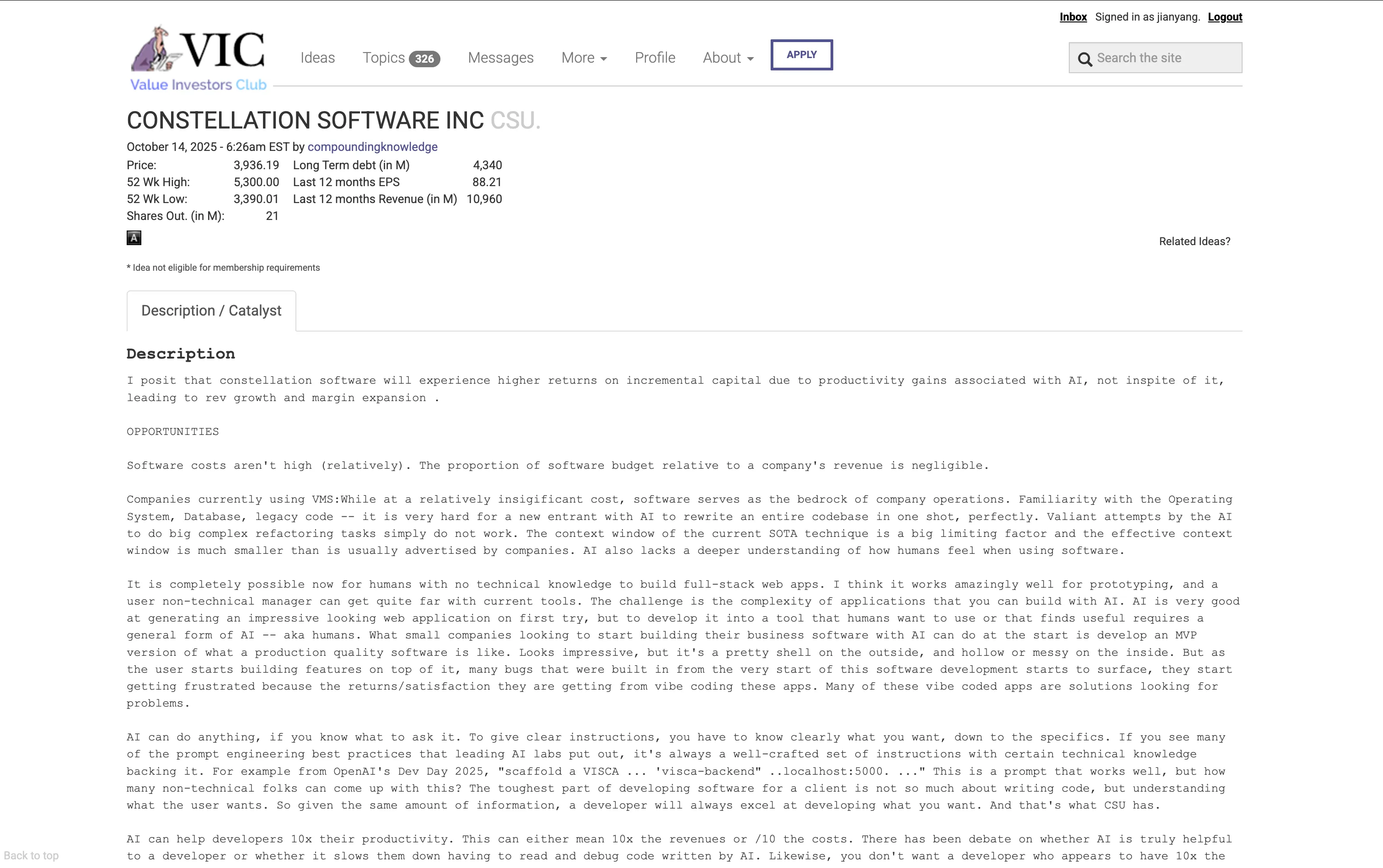
Figure 1: The original Constellation Software (CSU) pitch writeup submitted to Value Investors Club (VIC).
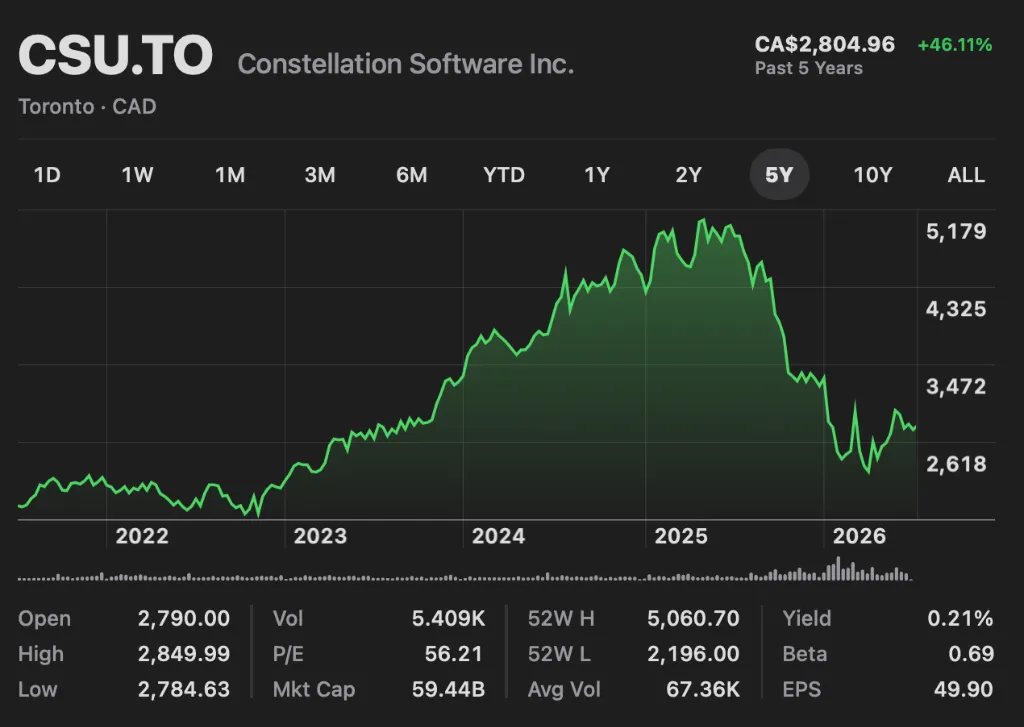
Figure 2: Constellation Software (CSU.TO) 5-year stock performance chart showing the recent price correction.
Description
I posit that Constellation Software will experience higher returns on incremental capital due to productivity gains associated with AI, not in spite of it, leading to revenue growth and margin expansion.
Opportunities
Software costs aren’t high (relatively). The proportion of software budget relative to a company’s revenue is negligible.
Companies currently using VMS: While at a relatively insignificant cost, software serves as the bedrock of company operations. Familiarity with the operating system, database, and legacy code makes it very hard for a new entrant with AI to rewrite an entire codebase in one shot, perfectly. Valiant attempts by AI to do big, complex refactoring tasks simply do not work. The context window of current state-of-the-art (SOTA) techniques is a big limiting factor, and the effective context window is much smaller than is usually advertised by companies. AI also lacks a deeper understanding of how humans feel when using software.
It is completely possible now for humans with no technical knowledge to build full-stack web apps. I think it works amazingly well for prototyping, and a non-technical manager can get quite far with current tools. The challenge is the complexity of applications that can be built. AI is very good at generating an impressive-looking web application on the first try, but to develop it into a tool that humans want to use or find useful requires a general form of AI (aka humans). What small companies looking to start building their business software with AI can do at the start is develop an MVP version of what production-quality software is like. It looks impressive, but it’s a pretty shell on the outside, and hollow or messy on the inside. As the user starts building features on top of it, many bugs that were built in from the very start of development start to surface, and they start getting frustrated with the returns and satisfaction they get from vibe-coding these apps. Many of these vibe-coded apps are solutions looking for problems.
AI can do anything, if you know what to ask it. To give clear instructions, you have to know clearly what you want, down to the specifics. If you look at the prompt engineering best practices that leading AI labs put out, they always require a well-crafted set of instructions with solid technical knowledge backing them. For example, from OpenAI’s Dev Day 2025: "scaffold a VISCA ... 'visca-backend' ... localhost:5000..." This is a prompt that works well, but how many non-technical folks can come up with this? The toughest part of developing software for a client is not writing code, but understanding what the user wants. So given the same amount of information, a developer will always excel at developing what you want. And that’s what CSU has.
AI can help developers 10x their productivity. This can either mean 10x the revenues or 1/10th the costs. There has been a debate on whether AI is truly helpful to developers or whether it slows them down by forcing them to read and debug AI-written code. Likewise, you don’t want a developer who appears to have 10x productivity with AI; it’s likely they are just accepting code without reading it, which can leave a trail of tech debt (sources of bugs/problems) that will surface in the future.
AI can lead to severe security issues. People who do not know how to use AI might leak important company information or resources to the public internet. There is a running joke in the community where you can search OPENAI_API_KEY on GitHub and see many vibe-coded applications that unintentionally leaked keys. For those who don’t know, this is like someone stealing your credit card. Such security breaches are incredibly damaging to a company’s hard-earned reputation, and the risk is too high for the reward of a lower software development cost.
The law of diminishing returns persists with coding models. To achieve a task well, it becomes less about writing code in the right syntax and more about understanding the true underlying problem at hand. I like to say that achieving that is equivalent to achieving Artificial General Intelligence (AGI), where we tell the AI, “Go figure out how to make a better version of yourself,” and it does just that. Leading experts in AI have said we are not getting anywhere near AGI, so we’ll likely have to stick to giving clear descriptions of what we want to an LLM.
For the foreseeable future, engineer-in-the-loop AI workflows are going to be the status quo. Companies with dedicated software teams who develop a mastery in using AI will be some of the biggest beneficiaries of this AI wave. However, this group has traditionally not been VMS’s target audience anyway. To most companies, software is insignificant enough to be outsourced to a third-party provider. Specialisation is the key here.
In light of all this, considering AI’s low cost relative to the critical importance of software reliability, maintainability, and scalability to a company (to avoid lost revenue or misplaced trust), I find it hard to fathom how customers will just stop requiring VMS software services simply because AI can build a nice, basic UI or a low-level full-stack application.
So who else can benefit from AI? None other than Constellation Software themselves. If Constellation Software embraces AI and forces its engineers to get comfortable using it and learning its quirks (doing so in a way that doesn’t harm code quality), their engineers’ productivity can most certainly increase. Constellation’s advantage in this AI era is their engineers’ technical skills. That gives them significantly more leverage in terms of what they can extract from these AI technologies. Used well, their engineers can develop software faster, development margins can expand (people don’t realize how cheap it can be to develop software now with AI), and clients can get creative prototyping with AI tools for CSU to build out, especially given the top-down imperative in many companies to integrate AI into their businesses.
AI is a horizontally enabling layer, and all of CSU’s customers stand to gain.
On the acquisition side, the story hasn’t changed much since the last VIC writeup. I have no doubt that the acquisition engine will continue running (we in fact see the acquisitions continue across CSU and its spinoffs like TOI). The ease of building software now will drive the creation of more software companies by technical folks, so I’m confident that there will be more VMS companies popping up with insights on how to use AI that CSU can learn from. Mark Miller has been with Mark Leonard since the start, and I’m fully confident as well that the acquisition discipline will continue. Mark Leonard has built an acquisition machine that can run without him, as it has for many years.
Concerns
I do fear that, given the software development leverage companies can get with AI, more of them will just hire a few software engineers who know the pros and cons of AI and use these tools well. This would be the true competitor to VMS and could lead to a decline in VMS services in the future. However, I do not think this outcome is likely. Specialisation forms the backbone of the global economy and we are all familiar with its advantages. Nvidia doesn’t just try to become the next OpenAI even if they could; they focus their efforts on designing chips, not building models. The risks (of bugs, security, and timeliness of fixes) simply do not justify the rewards of clients building apps themselves.
I do not have clear insight into CSU’s software engineers’ opinions on AI. There’s a general stigma in the wider software engineering community against using AI, associating it with the term “vibe coding,” a form of unserious, reckless coding. But there are real practical uses of AI that are definitely advantageous to CSU, and I strongly believe that the management needs to dedicate a specific team to explore the advantages of AI in the VMS space and share the learnings with their employees. I’m concerned about this because an executive on the recent AI call seemed to be part of this group and seemed to be critiquing AI more than recognising its positive impacts. The pace of coding models has been improving rapidly. But I am not overly concerned since there was only one executive I got this feeling from. I do like executive Paul’s comments on AI, however. Margins should increase over time.
Disclaimer: I do own shares in Constellation Software and Topicus, and I’m trying to understand how justified the recent “correction” in Constellation’s share price is. I welcome any contrasting views and am ready to change my opinions should a compelling argument come by.
Catalyst
Integration of AI tools, margin expansion, revenue growth